
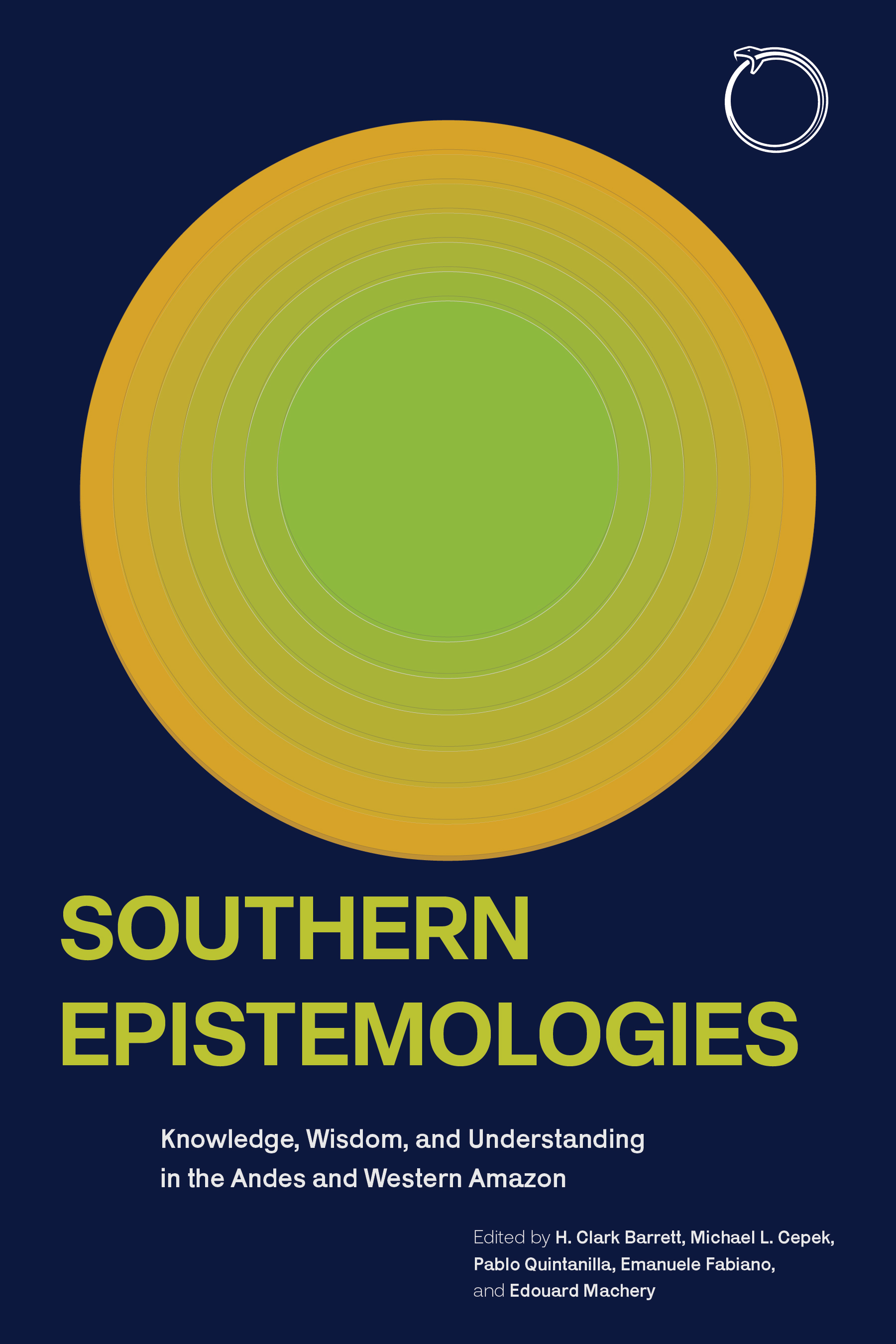
Knowledge, Wisdom, and Understanding in the Andes and Western Amazon
Edited by H. Clark Barrett, Michael L. Cepek, Pablo Quintanilla, Emanuele Fabiano, and Edouard Machery
What does it mean to know, and how is knowledge practiced? How can Indigenous perspectives challenge conventional concepts of knowledge in the Global North? Drawing on Indigenous epistemologies from the Andes and Western Amazon, Southern Epistemologies investigates how knowledge, wisdom, and understanding are shaped by local cultures, languages, bodies, and environments.
Bringing together linguists, philosophers, anthropologists, and Indigenous knowledge holders, the volume examines the dynamic interactions between culture, language, and place, showing how the unique linguistic histories and worldviews of Andean and Amazonian societies inform distinct ways of knowing. By interpreting these perspectives on their own terms, the book offers fresh insights into the plurality and diversity of human knowledge.
As the first volume specifically focused on Indigenous South American epistemologies, Southern Epistemologies foregrounds Indigenous knowledge systems and science while fostering dialogue with academic traditions. By opening new interdisciplinary and cross-cultural conversations, this groundbreaking volume challenges conventional notions of knowledge and illuminates how engagement with Indigenous perspectives can expand and enrich our understanding of what it truly means to know.
“I was especially impressed and even delighted by the deep, rich ethnographic and linguistic knowledge presented in the book; collectively, the many years of dedicated fieldwork with Indigenous interlocutors is truly impressive.”
— Mary Weismantel, Northwestern University
“Southern Epistemologies is an excellent and dynamic collection of essays that call for more attention to alternate systems of knowledge and knowing. The arguments and ethnographic data presented make for a deep and intelligent discussion about the problem of ‘knowledge’ and practices of ‘knowing’ across different cultures.”
— Michael Uzendoski, FLACSO, Ecuador
“For centuries, English-speaking philosophers have studied the concept of knowledge invoked by English speakers. But in recent years there has been a growing awareness that the concept of knowledge used by people in other cultures can be dramatically different. This volume, focusing on how knowledge is understood by cultures in the Andes and Western Amazon, provides a superb introduction to the astounding diversity to be found there.”
— Stephen Stich, Rutgers University
H. Clark Barrett is a professor of anthropology at UCLA and author of The Shape of Thought: How Mental Adaptations Evolve.
Michael L. Cepek is a professor of anthropology at the University of Texas at San Antonio and president of the Cofán Survival Fund. He is the author of Life in Oil: Cofán Survival in the Petroleum Fields of Amazonia.
Pablo Quintanilla is a professor of philosophy at Pontificia Universidad Católica del Perú and a senior research associate in the Department of the African Centre for Epistemology & Philosophy of Science (ACEPS), University of Johannesburg, South Africa. He is the author of Autoconocimiento y libertad. La vida por examinar.
Emanuele Fabiano is a postdoctoral researcher at the University of Barcelona. He is coeditor of Urban Imaginaries in Native Amazonia: Tales of Alterity, Power, and Defiance.
Edouard Machery is a distinguished professor of history and philosophy of science at the University of Pittsburgh, where he also directs the Center for Philosophy of Science. He is the author of Doing without Concepts and Philosophy within Its Proper Bounds.
© HAU Books 2026
ISBN: 9781914363504
ISBN: 9781914363528 (PDF)
306 pages | 6 x 9
$35
H. Clark Barrett
Michael L. Cepek and Cesario Lucitante
Jean Langdon
Amy Leia McLachlan
Sandhya Krittika Narayanan
David W. Fleck
Pablo Quintanilla
María Inés Silenzi
Jan David Hauck
H. Clark Barrett
Medardo Arahuate Manizari, Jorge Caringkia, Jervacio Gualinga Chuji, Mariano Tsetsekip Santi, Joshua Homan, Alejandro Erut, and Emanuele Fabiano
Laura Rival