
Prophets, Shamans, and the Transmission of Ritual Discourse in North American Indigenous Cultures, 1600–1900
By Pierre Déléage
Translated by Matthew H. Evans and Victoria Bergstrom
A groundbreaking study that rethinks the origins of writing, revealing how Native American ritual scripts expand our understanding beyond state-centered, universal models.
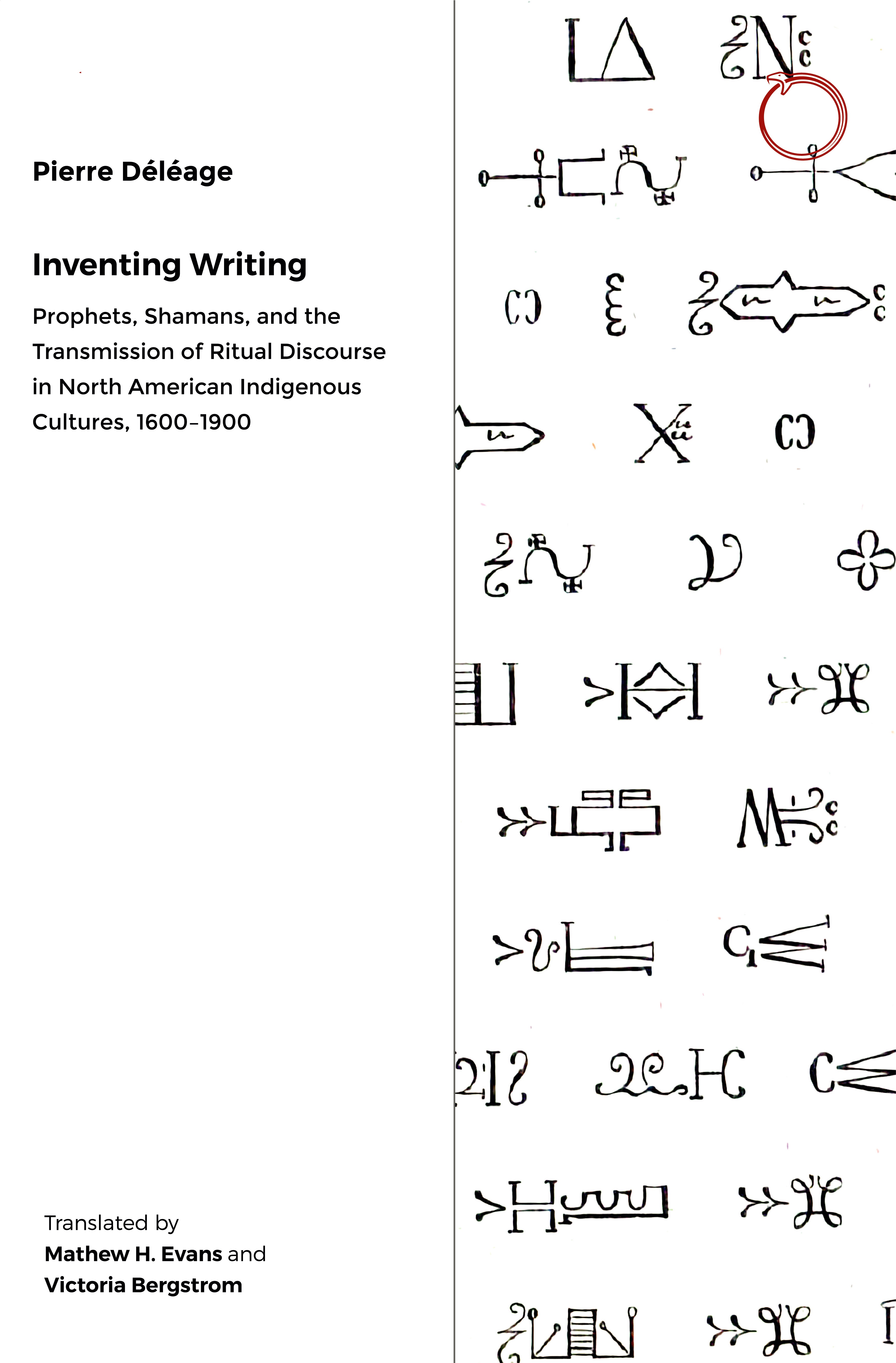
Why is it that, throughout their history, humans have repeatedly taken on the task of developing writing systems? Inventing Writing offers an array of conceptual tools for answering this question. In it, Pierre Déléage explores a series of cases involving the invention and use of writing systems by indigenous North American societies. Between the seventeenth and nineteenth centuries, a number of prophetic and shamanic movements developed original inscription techniques to ensure the transmission of ceremonial discourses. Examining these sources, the author formulates an innovative hypothesis: All of these invented writing systems can be defined as intended to transcribe specific ritual discourses within the institutional frameworks that governed their transmission and recitation. By focusing on the pragmatic functions of these North American scripts in their ritual contexts, Déléage allows us to rethink the problem of the invention of writing beyond the confines of evolutionary approaches that have classically focused on the great phonographic scripts of human history (Mesopotamian, Egyptian, Chinese, and Maya) and have never been able deal with selective writing systems on their own terms. Déléage’s approach offers a novel and promising argument for uncoupling the origin of writing from the genesis of the state, an association that many specialists in the field have long made.
“The trail is a major one: at its end may lie the new keys to understanding how the four original integral writing systems — Mesopotamian, Chinese, Maya, and Egyptian — capable of representing discourse, were invented.”
— Le Magazine Littéraire.
“Inventer l’écriture forcefully argues against vague categories like ‘pictography’ or ‘ideography’, and the outdated evolutionary theories that popularised them … This intriguing view may help explain why the rise of writing systems as we know them — systems that were complete, unbound and massively diffused at the same time — was such a rare event in history.”
— Olivier Morin, Central European University. Published in Social Anthropology
“While this book addresses specialists of North American history and Amerindian peoples by offering a new interpretation of their selective writing systems, it also offers an important historical and theoretical reflection on the history of writing in general.”
— Paul Cohen, University of Toronto. Published in Annales. Histoire, Sciences Sociales
“The work on the transmission and stabilization of Amerindian ritual discourses that Pierre Déléage has been carrying out for about ten years… operate a paradigm shift in the field of study of Amerindian writings and in the more general theory of writing … [and] opens the possibility of describing zones left unthought by the dualist theories of literate societies versus oral societies”
— Richard Lefebvre. Published in Recherches amérindiennes au Québec
“Inventer l’écriture [is] a magisterial comparative analysis of a number of Indigenous North American ritual techniques of inscription that he sees as central to the emergence of writing.”
— Emmanuel de Vienne, Paris Nanterre University. Published in Social Analysis
Pierre Déléage is an anthropologist and member of the Laboratoire d’Anthropologie Sociale of the Collège de France in Paris.
Matthew H. Evans is a writer, translator, and educator living in Lehigh Valley, Pennsylvania. He is also the translator of Charles Stépanoff’s Journeys into the Invisible (Hau Books 2025).
Victoria Bergstrom is assistant professor of French and Francophone Studies at Lehigh University.